

The WattPlan Podcast · Episode 41 · 11 min
Inside the winning power files from Unbound and The Traka
Read the transcript
James. Hello, and welcome to the WattPlan Podcast. I'm James. Dad, day job, the odd podium, building WattPlan, and an unhealthy amount of sports science. This week I've been staring at two power files, and honestly, they're bonkers. Mads Würtz Schmidt won The Traka and Unbound a month apart, and both rides are public. So how do you ride nine hours like that? Lyra's here, our AI research voice, and everything she cites is linked in the show notes.
Lyra. Steadily, which sounds dull until you see the numbers. At Unbound he held 302 watts of Weighted Power for nine hours. His best single hour in the whole race was only about ten watts more than that.
James. Ten watts. Over nine hours of Kansas gravel. That's insane. But before we go further, give everyone the three numbers we keep using, so nobody gets lost.
Lyra. Good idea. FTP, or threshold, is roughly the most power you can hold for an hour. His is about 405 watts. Weighted Power is what a surgy ride cost you, written as the steady power that would cost the same. It counts the hard bits more heavily, so a surgy ride sits well above its average.
James. And W prime?
Lyra. Think of a battery. Critical power is close to FTP, the line between power you can hold for ages and power you can't. W prime is the store of extra work above that line. Every second above it drains the battery, and it only charges again when you drop below the line.
James. FTP, the hour. Weighted Power, the cost of the surges. W prime, the battery. Got it. So what happened at Unbound?
Lyra. The early miles were thick mud, and a front group of fifteen or twenty went clear. After Texaco Hill at mile 62, he went with his teammate Keegan Swenson and Cobe Freeburn. Freeburn was dropped around mile 110. Then he flatted, and Swenson stopped and gave him his own rear wheel. Swenson's race was over. Würtz Schmidt rode the last three hours alone and won by five minutes.
James. Swenson gave up his own race. That's some teammate.
Lyra. And the file shows where. His longest stop of the day, three minutes 48, comes at mile 138, between the places the reports give.
James. So what did the move after Texaco Hill look like in the file? I'm picturing something enormous.
Lyra. It's his hardest twenty minutes of the whole day, up to the highest point of the course. 335 watts. That's about four fifths of his threshold. The effort that made the winning break was well below his FTP.
James. Hang about. Four fifths? I'd have bet money it was way over.
Lyra. Most of us would. And here's the bit that stands out. We counted every surge over 486 watts lasting ten seconds or more. There were sixteen, and every one came before kilometre 109. Then he rode 225 kilometres without a single one.
James. Not one? In the hardest gravel race in the world?
Lyra. Not one. In the bunch, his average power was low and his Weighted Power high, remember, the cost of the surges. In the break, the two almost met, because a steady effort has nothing for Weighted Power to weigh.
James. And after the flat? Borrowed wheel, nearly four minutes stopped, six hours in.
Lyra. This is the bit I'd call bonkers too. He came out of that stop and rode the next 17 kilometres at 316 watts, more than his average for any part of the race after the move. His best hour of the whole day runs straight through the wheel change. Then he held 297 watts alone for three hours.
James. That's not how my long rides go. By hour six I'm negotiating with myself about cafés.
Lyra. Same for most riders. And it wasn't a one-off. At The Traka a month earlier, sixteen of his eighteen surges came before kilometre 135. And the total work in the two races differs by three kilojoules, out of more than nine thousand.
James. Three. That's ridiculous. Two completely different races.
Lyra. Same shape, same total. It's how he races.
James. Is there a name for what he's doing?
Lyra. Durability, how much of your fresh power is still there after hours of work. A 2025 study in Frontiers in Sports and Active Living by Barsumyan and colleagues tested fourteen trained amateurs. Twenty minutes fresh, then again after 1,000 kilojoules. The more successful racers lost six and a half percent. The others lost twelve and a half. [7]
James. And he's done six and a half thousand kilojoules by the last three hours.
Lyra. And his best twenty minutes then was still around 95 percent of the best he rode that day. His race best isn't his fresh best, so it's not like for like, but the direction's clear.
James. Why stop surging, though? If he's that strong, why not keep attacking?
Lyra. Because hard efforts cost more than their share. A 2025 systematic review in the European Journal of Applied Physiology by Sánchez-Jiménez and colleagues looked at 21 studies of cyclists. Efforts above critical power cut later power more than the same work ridden easier. That's the W prime battery again, and draining it is expensive. [8]
James. But "pace yourself" is easy to say. What if it kicks off from the gun, with riders at my level, and they're riding over threshold? Do I just let them go?
Lyra. Usually not, and he didn't either. At Unbound he spent 35 minutes above his threshold in the first three hours, and twelve in the six after. He rode whatever it took to stay in the front group.
James. Because of the draft?
Lyra. Because of the draft. On flat roads in his first hour, in the bunch, he did about 37 kilometres an hour on roughly 200 watts. Alone after the flat, the same speed cost him about 300. Wind and gravel change through the day, so it's not a clean measurement, but it's the size the research predicts.
James. A hundred watts just for sitting in. That's bonkers.
Lyra. And a 2007 study in Medicine and Science in Sports and Exercise by Edwards and Byrnes backs it up. Thirteen competitive male cyclists, riding alone and then on a wheel. Drafting cut the power they needed by about 110 to 160 watts. So on a flat course, letting the front group go to protect your FTP can cost far more than following it. [9]
James. What about the break with Swenson? They shared the work, didn't they?
Lyra. They did, turn and turn about, and he still rode about 300 watts on the flat. In a small break everyone takes their turn in the wind, so the shelter's small. What sharing buys is speed. Three up, his 300 watts went at 40 kilometres an hour. Alone, at 37.
James. So when do I follow, and when do I let it go?
Lyra. Follow the moves that decide who's in the group, especially riders at your level. Then sit in, eat, and let your W prime battery charge. Don't spend it pulling, or chasing moves that don't matter.
James. Then the obvious question. How do you beat him?
Lyra. Not by out-pacing him. First, be in the move at mile 62. Everyone who missed it raced for second. Then make the chase work. Alone, he paid about 300 watts for his speed. A chase that really shares the work could, in theory, hold that speed for much less each.
James. And did the chase work?
Lyra. Not well enough, and that's the real difference. In front, two teammates shared the work. Behind, Cycling West reported Matt Beers had two Specialized teammates up the road, so he had little reason to chase. They finished five minutes down, even with his near four minute stop. A chase that won't cooperate is no threat.
James. Fine, but nobody listening is riding 302 watts for nine hours. What do I take from this?
Lyra. The shape, because it works at any power. He rode at about three quarters of his threshold. If you're new to this, and your first long gravel day is coming up, ride the opening hour easier than feels right, and start eating in the first hour.
James. Three quarters. So with a 250 watt FTP, about 190 watts of Weighted Power?
Lyra. Yes. If you train with power, use that as your target for the whole day, not your FTP. WattPlan's pacing calculator and Route analysis work the way he rode, harder on the climbs and easier downhill, from what you can hold for the whole ride.
James. And for anyone racing?
Lyra. If you race, spend your battery on the moves that make the race, then stop answering everything. And train the late part of the day. When your plan builds to a gravel event, WattPlan's long rides in the build and peak weeks can carry tempo blocks, the steady work these races live at.
James. What can't these files tell us?
Lyra. Quite a lot. Two rides, one rider. The power is his meter as Strava shows it. The threshold is our reading of his zones, the weight's a listing, and there's no heart rate. The race story comes from reports, which disagree on where the flat was.
James. Give me something to do before my next long ride, then.
Lyra. Take the route file for your next long ride and run it through the free pacing calculator on wattplan.cc, with your FTP and weight. Note the power it gives you for the biggest climb. Then on the ride, let the climbs take the extra, keep the flat steady, and pick your surges.
James. Biggest climb's number written down, flat kept steady, and only the surges that matter.
Lyra. The move that won Unbound was twenty minutes below his FTP. Everything else was keeping the battery charged for when it mattered.
Lyra. The full article and every study we mentioned are on the WattPlan blog, linked in the show notes. And if you've enjoyed this, follow the WattPlan Podcast wherever you're listening, so you don't miss the next one.
James. And if you want a plan built around the time you've actually got, get WattPlan on the App Store or Google Play. Thanks for listening.
Voices produced with ElevenLabs. James's voice is a clone of his own, Lyra is an AI voice, and James reviews every script before it is published.
Mads Würtz Schmidt won The Traka 360 on 1 May 2026 and Unbound Gravel 200 four weeks later, two of the biggest gravel races in the world. Both rides are public on his Strava, with power, so we went through them second by second. The numbers are bonkers. At Unbound he held 302 W of Weighted Power for nine hours, and his best single hour in the race, 312 W by our count, was only 10 W higher than that.
The two files
Everything below is WattPlan's own reading of his two public Strava files, Unbound and The Traka 360, read on 17 October 2026. Where a figure is Strava's own, we say so. The rest we calculated from his power, speed, gradient and elevation over moving time. There is no heart rate in either file.
| Unbound 200 | The Traka 360 | |
|---|---|---|
| Date | 30 May 2026 | 1 May 2026 |
| Distance | 334 km | 316 km |
| Climbing | 1,819 m | about 3,800 m |
| Moving time | 9:09 | 9:47 |
| Average power | 285 W | 266 W |
| Weighted Power (ours) | 311 W | 308 W |
| Total work (ours) | 9,385 kJ | 9,382 kJ |
| Surges over 486 W, 10 s or longer | 16 | 18 |
Two races on very different courses, a month apart, and the total work differs by 3 kJ. Three. Strava's own figures for Unbound are 302 W of Weighted Power and 9,396 kJ. Ours come out a little different because we counted moving time only, so we use ours to compare one race, or one part of a race, with another.
His zones on Strava put his threshold at about 405 W. ProCyclingStats lists him at 70 kg, so at Unbound that's about 4.3 W/kg of Weighted Power for nine hours, and about 5.8 W/kg at threshold. Those are his listed weight, not a measurement, so treat every W/kg here as approximate.
The numbers in this post, in plain words
FTP and threshold. Roughly the highest power you can hold for about an hour. We use the two words for the same thing. His Strava zones put his at about 405 W.
Weighted Power. What a ride with surges cost you, written as the steady power that would have cost the same. It counts hard spells more heavily than easy ones, so a surgy ride's Weighted Power sits well above its average power, and a steady ride's sits almost on it. The gap between the two is a quick read of how surgy a ride was.
Critical power and W prime. Critical power is close to FTP, the line between power you can hold for a long time and power you can't. W prime is the store of extra work you can do above that line, measured in kilojoules. Think of it as a battery. Every second above critical power drains it, and it only charges again when you ride below the line, faster the easier you ride.
Kilojoules (kJ). The total work done at the pedals. Handily, it's also about the number of kilocalories your body burned to do it.
W/kg. Power divided by body weight, what decides speed uphill.
How did Unbound unfold?
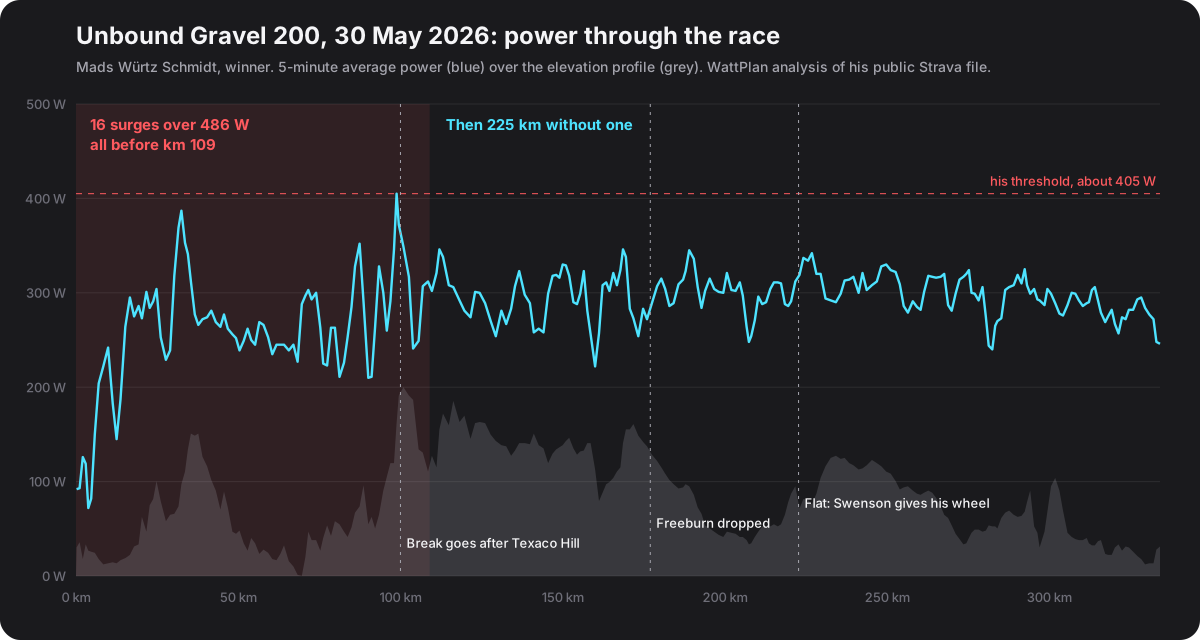
The race reports and his file tell the same story. Overnight storms turned the early miles into thick mud, and by mile 11 a front group of 15 to 20 riders had gone clear. After Texaco Hill at mile 62, he went with Keegan Swenson and Cobe Freeburn. Freeburn was dropped around mile 110. Then Würtz Schmidt flatted, and Swenson, his Specialized teammate, stopped, tried to fix it, and gave him his own rear wheel. Swenson's race was over, and Würtz Schmidt rode the rest alone to win in 9:14:51, 5:03 ahead of Matt Beers.
The reports place the flat anywhere from mile 120 to mile 150. His file pins it down. His longest stop of the day, 3 minutes 48 seconds, comes at km 223, mile 138.
| Part of the race | Distance | Time | Average power | Weighted Power | Above threshold |
|---|---|---|---|---|---|
| In the bunch | km 0 to 92 | 2:32 | 251 W | 304 W | 27 min |
| The move, over Texaco Hill | km 92 to 104 | 0:20 | 332 W | 363 W | 6 min |
| Three up, with Swenson and Freeburn | km 104 to 177 | 1:51 | 296 W | 316 W | 8 min |
| Two up, with Swenson | km 177 to 223 | 1:16 | 298 W | 310 W | 3 min |
| Alone, after Swenson gave him his wheel | km 223 to 334 | 3:09 | 297 W | 306 W | 4 min |
We counted every surge over 486 W, his VO2max zone, that lasted 10 seconds or more. There were 16, and all 16 came before km 109, in the bunch and the move that split it. Then he rode 225 km, about six hours, without a single one.
His hardest 20 minutes of the whole day ran from km 92 to km 104, up to the highest point of the course, at 335 W. That's the move after Texaco Hill, and it's about 83% of his threshold. The effort that made the winning break was well below his FTP.
And then the bit that's frankly bonkers. After a 3 minute 48 stop, a borrowed wheel and six hours of racing, he rode the next 17 km at 316 W, more than his average for any part of the race after the move. Alone, with the chase behind him, he held 297 W for the last three hours.
Why did his power go up as the race went on?
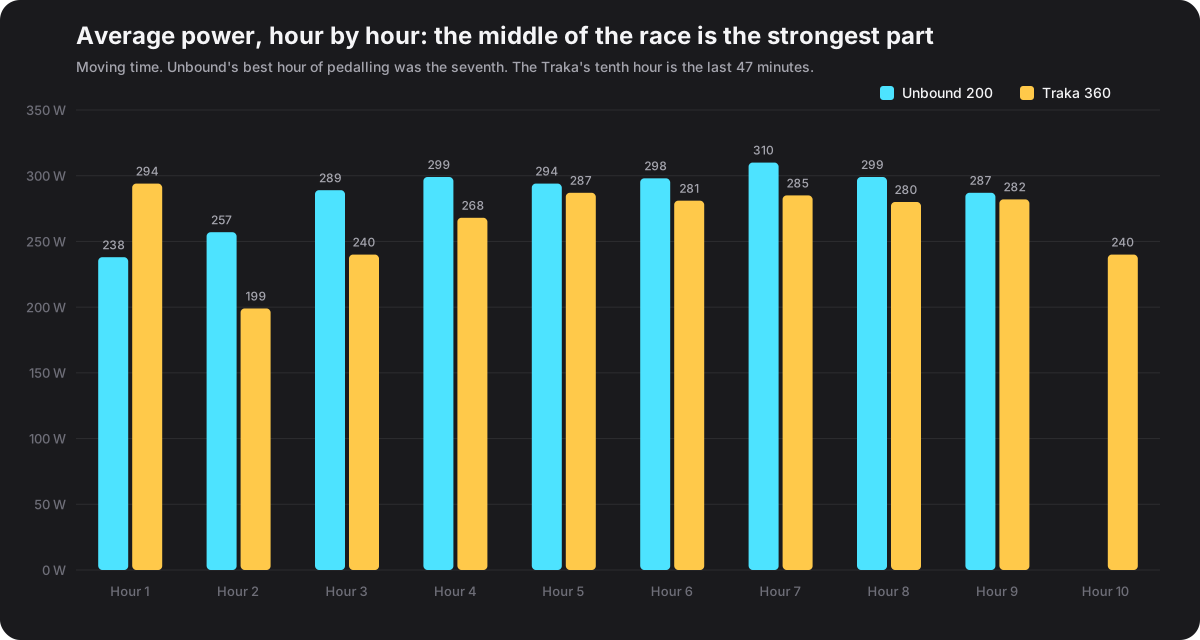
At Unbound his average power climbed through the first four hours and peaked in the seventh.
| Hour | Average power | Weighted Power | Speed | Coasting |
|---|---|---|---|---|
| 1 | 238 W | 307 W | 35.2 km/h | 8% |
| 2 | 257 W | 291 W | 37.1 km/h | 8% |
| 3 | 289 W | 338 W | 37.1 km/h | 7% |
| 4 | 299 W | 318 W | 42.2 km/h | 3% |
| 5 | 294 W | 310 W | 35.9 km/h | 4% |
| 6 | 298 W | 309 W | 35.0 km/h | 3% |
| 7 | 310 W | 319 W | 40.9 km/h | 2% |
| 8 | 299 W | 310 W | 32.4 km/h | 3% |
| 9 | 287 W | 292 W | 33.2 km/h | 1% |
The gap between the two power columns tells the story. In the first three hours, in the bunch, his average power was low and his Weighted Power high. That's what surging, freewheeling and sitting on wheels look like in a file. From hour four, in a break of three and then two, the two numbers almost meet, because a steady effort has nothing for Weighted Power to weigh. His highest average hour of the whole race was the seventh, at 310 W, his first hour alone after the flat.
By our count his best hour of the day started 5 hours 45 minutes in, at km 215, eight kilometres before the flat, after he'd already done 5,782 kJ of work. It runs straight through the wheel change and into his first 45 minutes alone. That is insane. Most of us are fading by then. He was doing the best hour of his day.
How did he pace the climbs?
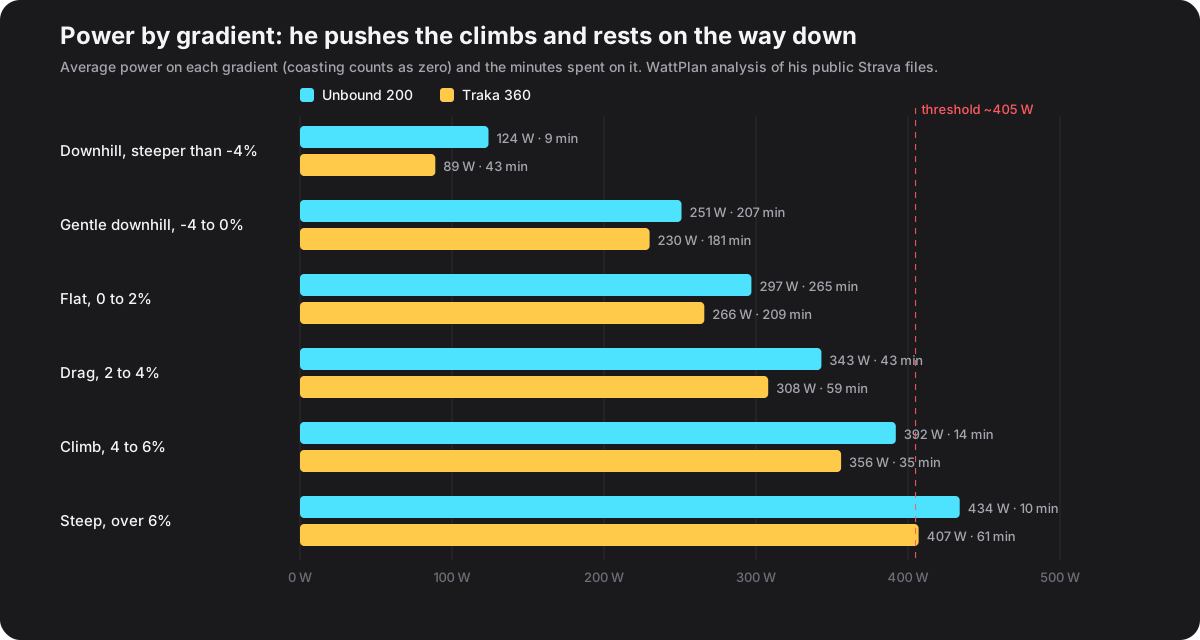
He pushed every climb and rested on the way down. At Unbound he averaged 297 W on the flat, 343 W on 2 to 4%, 392 W on 4 to 6%, and 434 W on anything steeper. On descents steeper than 4% he coasted 39% of the time. Kansas is a pedalling course, and about 80% of his moving time was between -2% and +2%.
Strava puts 21% of the ride in his recovery zone, under 223 W. The file says he coasted for only 4% of the ride. Much of that "recovery" is easier pedalling on the long false-flat descents, where he spent nearly three hours averaging 262 W, which is easy only next to everything else he did that day.
Was The Traka the same?
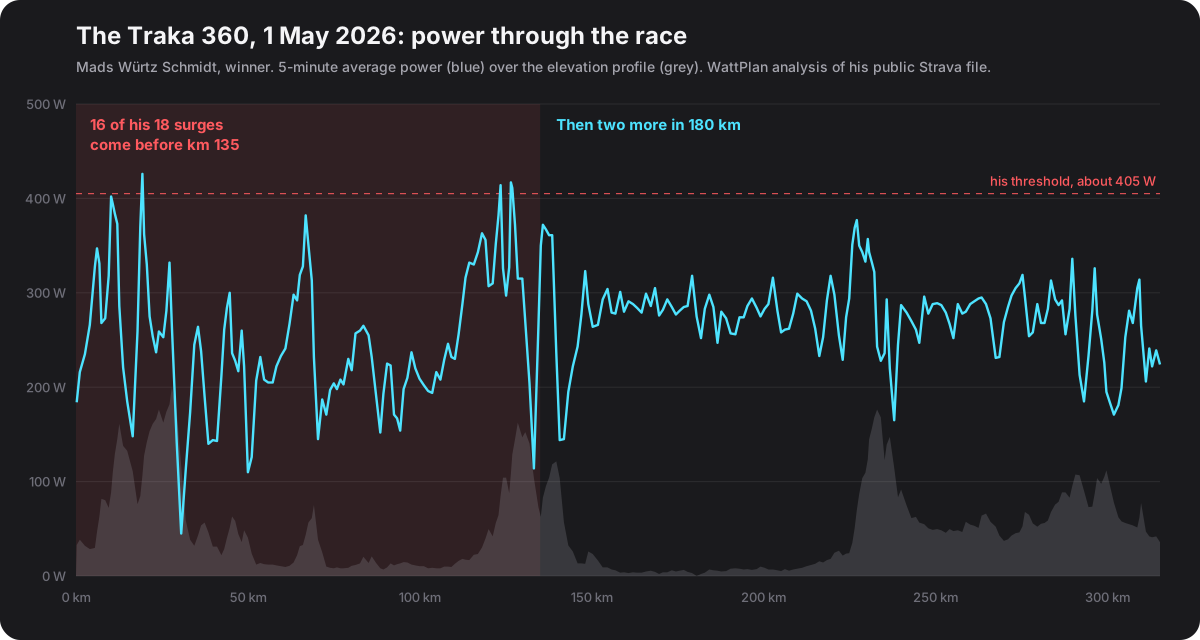
Almost a twin. At The Traka, 16 of his 18 surges came before km 135, and in the last 180 km there were just two more. His Weighted Power was 315 W in the first half and 301 W in the second, against 315 W and 307 W at Unbound.
The Traka is the hillier race, and the file shows it. He spent about an hour on gradients over 6%, at 407 W on average, against ten minutes at Unbound. That's about an hour at his threshold, in pieces, across nearly ten hours. His best 20 minutes, 375 W, started nearly four hours in, at km 121. His slowest hour was the second, at 199 W with 19% of it coasting, which is the bunch sitting in early.
Two of the biggest gravel races, two different courses, and the files have the same shape. That's no accident. It's how he races.
How durable is that?
Durability is how much of your fresh power is still there after hours of work. Ed Maunder and colleagues gave it its working definition in a 2021 review in Sports Medicine, and it's the quality these files show off.
The comparison that makes our jaws drop is with amateurs. Barsumyan and colleagues tested 14 trained amateurs in 2025, who rode a 20 minute time trial fresh, then again after 1,000 kJ of riding. The more successful racers lost 6.5% of their 20 minute power, the others 12.5%.
He passed 1,000 kJ in under an hour at The Traka. In the last three hours of each race, after about 6,500 kJ, his best 20 minutes was still 94% of the best 20 minutes he rode in that race, at The Traka, and 95% at Unbound. His race bests aren't his fresh bests, so his real drop is bigger than that, and a race is not a lab test. But that's six and a half times the work that cost the amateurs 6.5 to 12.5% of their power. Frankly bonkers.
The 2025 systematic review by Sánchez-Jiménez and colleagues, reviewing 21 studies of cyclists, adds the other half of the story. Efforts above critical power, roughly the hardest you can keep up for a long time, cut later power more than the same work ridden easier. His files read like someone who knows it. The expensive efforts come early, when the race forces them, and then they stop.
What if the race goes from the gun?
Then you go with it, if it's the move that matters. That's what the winner did. Pacing yourself is easy to say, but at Unbound he spent 35 minutes above his threshold in the first three hours, and only 12 minutes in the six hours after. At The Traka it was 30 minutes in the first three. He didn't ride the start at a sensible share of his FTP. He rode whatever it took to stay in the front group.
The reason is the group. On flat roads in the bunch, over the first 92 km at Unbound, he rode at 37.5 km/h on 235 W, and in the first hour at 36.8 km/h on about 200 W. Alone after the flat, the same speed on flat roads cost him 297 W. The wind and the gravel change through the day, so that's not a clean measurement. But it's the size the research predicts.
A small break is a different deal. Three up and then two up with Swenson, they shared the work, and he still rode about 300 W on flat roads. In a break of two or three everyone takes turns in the wind, so the shelter is smaller and you pay for the speed. What sharing buys is speed. Three up, his 300 W on flat roads went at 40 km/h. Alone after the flat, the same power went at 37 km/h.
- Edwards and Byrnes, in Medicine and Science in Sports and Exercise in 2007, measured 13 competitive male cyclists riding alone and on a wheel. Drafting cut their drag by 36 to 50%, and the power they needed by about 110 to 160 W, more behind a bigger rider.
- Blocken and colleagues, in 2018, modelled two bunches of 121 riders and tested them in a wind tunnel. Earlier work had small lines of riders at 50 to 70% of a lone rider's drag. Deep in the middle and back of a big bunch it fell to 5 to 10%.
So on a fast, flat course, riding to your FTP and letting the front group go can cost far more than following it. Once you're out of the group, you pay the full price of the wind on your own for the rest of the day.
The bill comes from your W prime, the store of work you can do above critical power. Philip Skiba and colleagues modelled it in 2012. Every second above critical power spends it, and it only comes back when you ride below critical power, faster the easier you ride. And the Sánchez-Jiménez review says that hard work costs more later than easy work. So spend above threshold on the moves that decide who is in the group. Then sit in, recover in its shelter, and eat. Don't spend it on moves that don't matter, or on pulling a group that will ride the same speed without you.
If you know the riders at your level, their move is usually the one to follow. Once WattPlan's Route analysis knows your critical power, it warns you to avoid surges when your W prime drops below 40%. That's the point where one more chase costs you the finish.
How do you beat him?
Not by out-pacing him. He held about 300 W for six hours after the break went, and his best hour came late.
Be in the move. The race was made after Texaco Hill at mile 62, and for him that move was a 20 minutes at about four fifths of his threshold. Everyone who missed it raced for second.
Make the chase work. Once he was alone, he paid about 300 W for his speed on the flat. A chase that really shares the work can, in theory, hold that speed for much less power each, because each rider spends only part of the time in the wind. That's the real difference between the break and the chase at Unbound. In front, two teammates shared the work. Behind, Cycling West reported that Matt Beers, in the chase, had two Specialized teammates up the road, which left him little reason to chase. The chase finished 5:03 behind, even though Würtz Schmidt had stopped for nearly four minutes. A chase that won't cooperate is no threat at all.
Hope for bad luck, and no teammate. His only real wobble was the flat at mile 138. It took his teammate's own wheel to keep him in the race.
Making the early race harder costs everyone, and in the Barsumyan study it was the less durable riders who lost most. Against a rider like this, the one who loses most is probably not him.
What does this mean for an amateur?
Nobody reading this is riding 302 W for nine hours. The shape is what travels, and the shape works at any power.
Pace it at a share of your threshold. He rode Unbound at about 75% of his threshold. With a 250 W FTP that's about 190 W of Weighted Power. For most amateurs on a long gravel day, that share of FTP is the right ballpark as a target for the whole day. It's the nine hours that's elite. If you're new to long events, ride the opening hour easier than feels right and start eating in the first hour.
Pick your surges. Every surge he made came in the opening third, when staying with the front group mattered. Then he stopped. On a sportive or gravel event most of us do the opposite, letting the important move go and then chasing every wheel in hour four.
Push the climbs, use the descents. His power rose with every step of gradient and fell away downhill. WattPlan's free pacing calculator and Route analysis pace a ride this way, harder on the climbs and easier on the way down, from the power you can hold for the whole predicted time.
Fuel for the work. About 9,400 kJ of work is roughly 9,000 kcal burned, because the body turns only about a quarter of its energy into work at the pedals, which makes kilojoules and kilocalories come out about the same. That's around 1,000 kcal an hour. We don't know what he ate and won't guess. WattPlan's in-ride reminders prompt 60 g of carbohydrate every 45 minutes, 80 g an hour.
Train the late part of the day. When your plan builds to a gravel event, WattPlan's long rides in the build and peak weeks can carry tempo blocks, the steady intensity these races live at. Then check your own durability the way the files do. Compare your best 20 minutes late in a long ride with your best early in it.
What we don't know
These are two files from one rider. The power comes from his power meter as Strava displays it, and we haven't seen his calibration. The threshold is our reading of his Strava zones, and the weight is a listing. There's no heart rate, so we can't say how hard any of it felt. The race story comes from the reports, which disagree on where the flat happened, and we've matched it to his file where we can.
The amateur studies are small. Barsumyan had 14 riders and found an association, not proof that durability wins races, and their protocol was a set test, so his race numbers aren't directly comparable. Researchers measure durability in different ways, which makes their results hard to compare.
Sources
- UNBOUND 🥇🏆, Mads Würtz Schmidt's ride file, 30 May 2026, Strava
- Traka 360 🥇, Mads Würtz Schmidt's ride file, 1 May 2026, Strava
- Mads Würtz Schmidt, Sofía Gómez Villafañe Win UNBOUND Gravel 200, Cycling West
- Brief report and big gallery: a mudfest at Unbound Gravel 200, Escape Collective
- Mads Würtz Schmidt, rider profile, ProCyclingStats
- The Importance of 'Durability' in the Physiological Profiling of Endurance Athletes, Sports Medicine
- Enhanced durability predicts success in amateur road cycling: evidence of power output declines, Frontiers in Sports and Active Living
- Is intensity the most important factor in determining the amount of prior work accumulated that affects cyclists' acute durability? A systematic review, European Journal of Applied Physiology
- Aerodynamic Characteristics as Determinants of the Drafting Effect in Cycling, Medicine & Science in Sports & Exercise
- Aerodynamic drag in cycling pelotons: New insights by CFD simulation and wind tunnel testing, Journal of Wind Engineering and Industrial Aerodynamics
- Modeling the Expenditure and Reconstitution of Work Capacity above Critical Power, Medicine & Science in Sports & Exercise